Glimpy – math trainer for times tables and mental math
The iPhone app that asks the questions. For ages 5–10, offline, no ads. Get it on the App Store

iPhone app · ages 5–10 · first 100 problems free · one-time purchase, no subscription
Demo ready.
Five problems. The whole Glimpy feeling.
Start, answer and get immediate feedback. These five problems are just the browser demo. The iPhone app on the App Store turns that same loop into fresh ten-problem rounds at the selected level.
- Start calmly.One tap begins a short, focused round.
- Answer simply.Large number keys keep attention on the calculation.
- Learn immediately.Glimpy celebrates correct answers and reveals the solution after mistakes.
What Glimpy trains
Difficulty grows with the child: first sums, carrying, then the times tables. All of it in the iPhone app on the App Store.
- Times tablesDrill one table for a whole round.
- Carrying and borrowingFrom sums within ten through to mixed arithmetic.
- Five levelsAddition, subtraction, multiplication and division.
- 100 problems freeThen a one-time purchase. No subscription.
Five levels. Clear progress. Focused repetition.
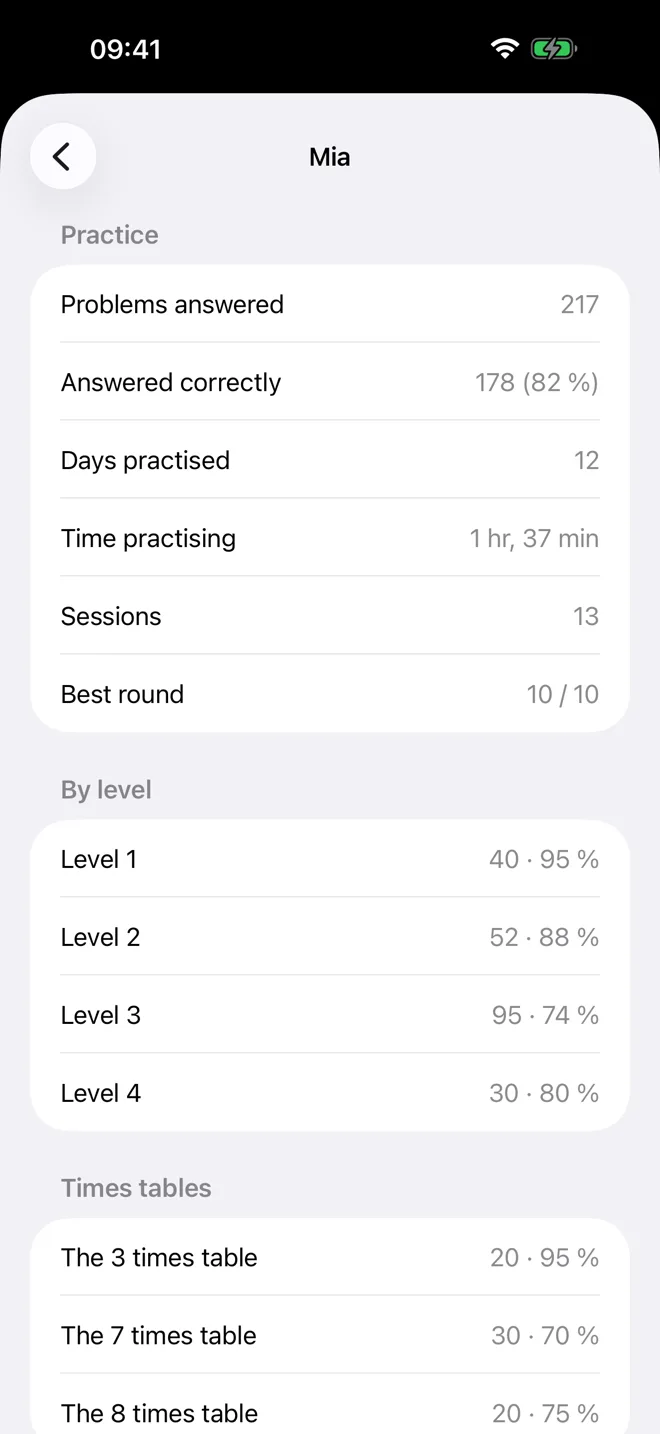
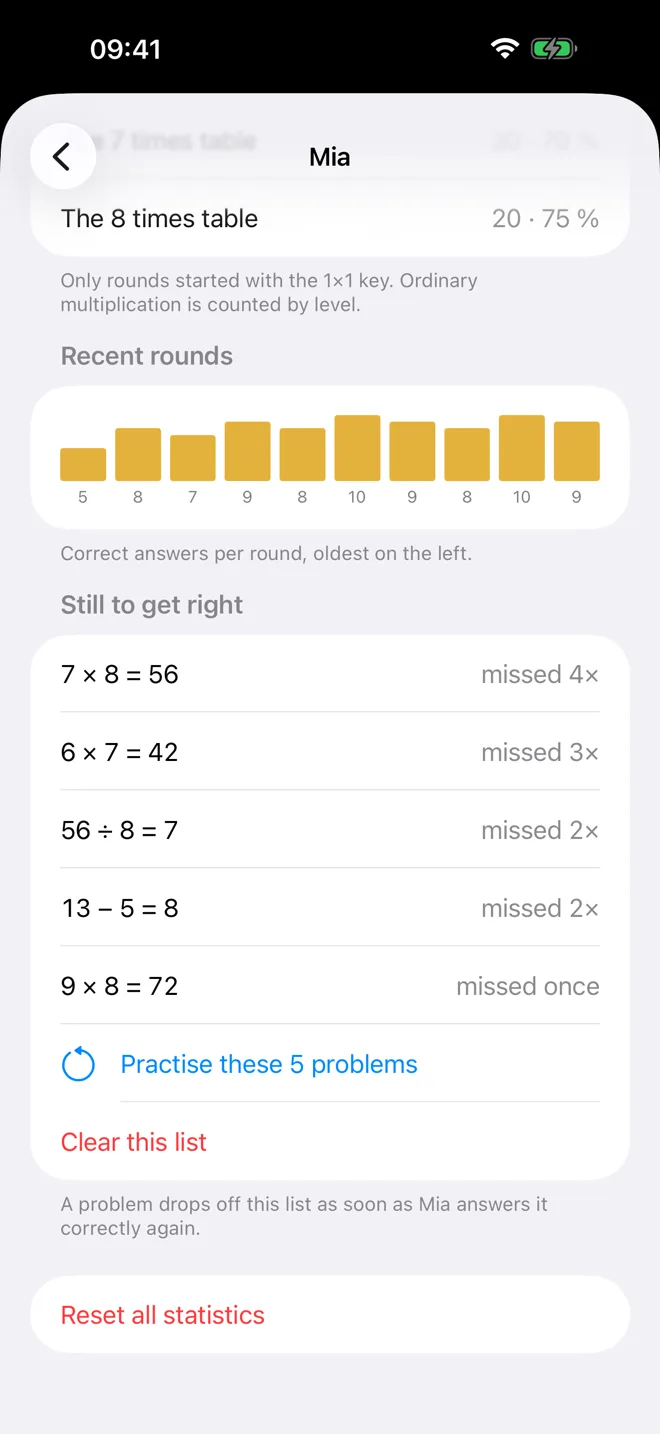
In the iPhone app, Glimpy grows from first sums to mixed arithmetic. Parents see progress at a glance, and missed problems become the next focused practice round.
- 5LevelsFrom first sums to mixed arithmetic.
- 4OperationsAddition, subtraction, multiplication and division.
- Mistake?Practise it againTurn difficult problems into a focused follow-up round.
The curriculum
Five levels from preschool to year 4.
Glimpy is designed for roughly ages 5 to 10. Its progression follows the broad sequence shared by primary curricula across many industrialised countries: number sense and addition and subtraction first, multiplication and division facts next, then larger number ranges and structured mental strategies. The exact year in which a topic appears varies by country, school and child.
- Preschool & year 1 · ages 5–7
First number sense
Addition and subtraction only, in the number range to 30. Rounds build from work to 10 through 11–20 to 21–30, with first carrying and borrowing introduced sparingly.
- Early year 2 · ages 7–8
The four operations begin
Addition and subtraction focus on the number range from 30 to 70. The small tables and matching exact divisions are introduced with factors to 10, starting with the easier 2, 5 and 10 families.
- Later year 2 · ages 7–8
Consolidating the basics
Addition and subtraction progress from 30 to 100 with more carrying and borrowing. The complete small tables to 10 × 10 and their matching divisions are consolidated.
- Year 3 · ages 8–9
Larger numbers, simple methods
All four operations in the number range to 1,000. Large tables to 20 × 20, multi-digit × one-digit multiplication such as 54 × 9, and exact division by a one-digit divisor such as 312 ÷ 2.
- Year 4 · ages 9–10
Mental strategies with larger numbers
All four operations in the number range to 1,000, now with greater mental demand. Multiplication uses recognisable strategies such as round tens, ×11, ×12, ×15, ×25 and ×50. Division stays mental too: divisors are 2 to 9 or the simple 10, 15, 20, 25 and 50, with compatible dividends such as 420 ÷ 7 or 900 ÷ 15.
Maths stays on the device.
- No account
- No advertising or tracking
- No analytics SDK
- No network connection required for practice

Good to know.
- Who is Glimpy for?
- Glimpy is an iPhone app for children aged roughly 5 to 10, from preschool and the first year of primary school through year 4.
- What can children practise?
- Addition, subtraction, multiplication and division across five levels. Normal rounds mix the operations for that level; the 1×1 key selects one operation and number for focused practice.
- How do the five levels differ?
- Level 1 uses addition and subtraction to 30. Level 2 introduces all four operations and works to 70. Level 3 consolidates the small tables and reaches 100. Level 4 moves to 1,000, the large tables and simple one-digit methods. Level 5 stays within 1,000 but uses more demanding, deliberately mental multiplication and division strategies.
- Do the levels follow school curricula?
- Their broad progression follows a pattern common to primary curricula across many industrialised countries: number sense and addition and subtraction first, multiplication and division facts next, then larger numbers and structured strategies. The exact timing and number ranges vary, so the school years and ages are orientation rather than a fixed assessment.
- How much does it cost?
- The first 100 problems are free. Glimpy Pro is a lifetime deal: one in-app purchase unlocks unlimited practice permanently. It is not a subscription and there are no recurring payments. Each additional child profile is a separate lifetime one-time purchase.
- Does Glimpy collect data?
- The app has no accounts, ads, analytics or tracking. Profiles, settings and learning progress stay locally on the iPhone. Purchases are handled by Apple.
- Which language does the app use?
- The interface and parent guide follow the device language in English or German. The child-facing practice is largely numeric and requires very little reading.
- Is the web demo the full app?
- No. The demo intentionally repeats the same five problems. The iPhone app contains the levels, full practice rounds, progress statistics, mistake practice and profiles.
Five problems in the browser. The iPhone app on the App Store.